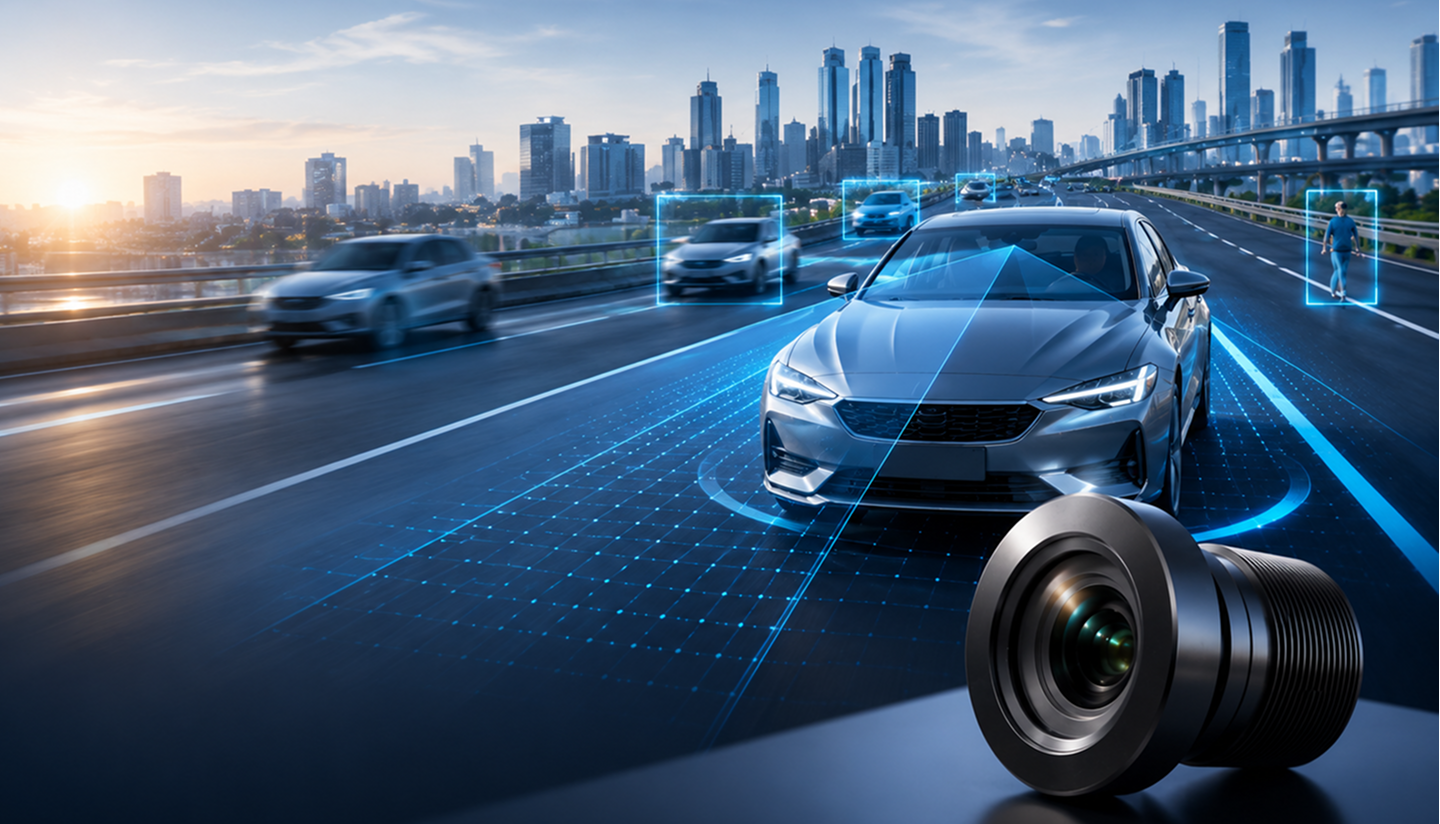
Efour Advances Real-Time Vehicle Intelligence With AI-Driven Automotive Camera

An AI-enhanced automotive camera integrates on-device inference, multi-interface connectivity, and full vehicular protection. The redefined version visualizes intelligence across ADAS, fleet, and connected vehicle platforms.

Jul 28, 2026NY, United States
Efour Advances Real-Time Vehicle Intelligence With AI-Driven Automotive Camera

Efour, a product engineering company, has officially leveled up the Automotive Grade Camera with Embedded AI. This is a significant advancement in the embedded hardware engineering space of Efour, as are the operational demands of modern vehicle systems. The automotive camera is built on the Renesas RZV2 platform with Sony image sensors. It goes beyond passive video capture into active embedded AI. Now, it delivers real-time visual intelligence directly at the vehicle level, without cloud dependency.


Engineered for automotive OEMs, fleet operators, Tier-1 suppliers, and connected vehicle platform developers, Efour has deployed the bulk orders of cameras to European regions. They are designed for the full spectrum of vehicle-side applications. From the rearview monitoring, parking assist, ADAS integration, and driver monitoring systems, the device has a multi-camera surround-view architecture.

Introducing Renewed Efour’s AI-Enhanced Automotive-Grade Camera


The new AI-Automotive cameras are centralized ECUs or cloud infrastructure to process and act on what they see. For next-generation vehicle platforms where milliseconds determine safety outcomes, that architecture is no longer sufficient. The product process latency, network dependency, and computational overhead of centralized vision processing. Therefore, it fills gaps that embedded AI at the camera level is uniquely positioned to close.


Efour’s Automotive Grade Camera is engineered with embedded AI that specifically makes a great shift. It places AI inference at the sensor edge for advanced solutions. Inside a camera unit built to survive the full harshness of the automotive environment. Moreover, the Efour’s Automotive Grade Camera provides the following:

On-device AI inference via Renesas RZV2 runs object detection, pedestrian recognition, and visual anomaly classification directly at the camera level. It eliminates processing latency for safety-critical visual decisions and removes dependence on centralized ECU compute for time-sensitive events.

1080P and higher resolution capture via MIPI CSI-2 delivers high-fidelity visual input across rearview, parking assist, ADAS, and surround-view applications. In this, Sony’s image sensor ensures reliable performance in low-light, high-contrast, and adverse weather conditions.

Hardware-accelerated H.264/H.265 decode pipeline processes video efficiently on-device, optimizing bandwidth consumption and storage utilization. It works across high camera count fleets and multi-ECU vehicle architectures.

Multi-interface connectivity—100M/1G Ethernet, Wi-Fi, & BLE enables integration across modern vehicle communication networks, fleet management platforms, and wireless diagnostic systems. That too, without additional gateway hardware.

Wide-range vehicular power input, 9V to 36V AC. This makes the product accept power directly from the vehicle battery with ignition-triggered startup and graceful shutdown. Alongside, it ensures the camera powers on and off in synchronization with vehicle ignition cycles without manual intervention or power surge risk.

Full automotive-grade electrical protection covering reverse polarity, over-voltage, transient suppression, and EMI filtering. So, the device operates reliably across the full electrical noise profile of the environment. It enables everything from engine start transients to high-current switching events.

Operating temperature range of -40°C to +85°C qualifies the device for deployment across the full automotive thermal envelope. The system is also built to withstand high-temperature desert environments and under-hood conditions without any degradation in performance.

The Efour’s advanced  Automotive Grade Camera, from commercial-grade alternatives, is its architecture-level readiness for vehicle integration. The platform is designed for automotive OEMs requiring AI vision capabilities without centralized processing overhead. It is deploying multi-camera monitoring across large vehicle populations.


Hitesh Gambhava, COO at Efour, said, “As the automotive industry shifts toward edge AI and software-defined vehicles, intelligence must happen at the point of capture. By embedding AI directly into our automotive camera using the Renesas RZ/V2 platform, we enable a real-time detection and decision-making solution. It is thermal and electrical limits, helping OEMs and Tier-1s build faster, safer, and smarter vision systems.”


Paresh Sagar, CEO at Efour, said, “The automotive industry is at an inflection point where every camera on a vehicle is expected to be an intelligent sensor, not a passive recorder. Efour’s Automotive Grade Camera is our answer to that expectation, with embedded AI, automotive-grade resilience, and multi-interface connectivity built into a single production-ready module. This launch advances our connected hardware portfolio into one of the most demanding and consequential engineering domains there is, and it is a product we are confident will set a new standard for what vehicle-side visual intelligence looks like.”

About Efour

Efour is a global end-to-end product engineering company specializing in AI, IoT, embedded systems, firmware engineering, and connected enterprise technologies. The company works with enterprises, OEMs, and government organizations worldwide and delivers ISO-compliant, CE-marked products. From prototyping, industrial design, production, and go-to-market execution, we strive to deliver everything under one roof.

For media enquiries, connect: seo@efour.co

Efour Advances Real-Time Vehicle Intelligence With AI-Driven Automotive Camera