Machine Vision Inspection for Packaging Lines: A Retrofit Buyer’s Guide

Before adding machine vision inspection to an existing packaging line, assess what the retrofit will require. This guide helps packaging-equipment manufacturers evaluate feasibility, specify defect detection and reject handling, and compare supplier quotations against measurable acceptance criteria.

Hitesh Gambhava
Nov 17, 20266 min readUpdated Nov 18, 2026
Share:
Share article on LinkedInShare article on X
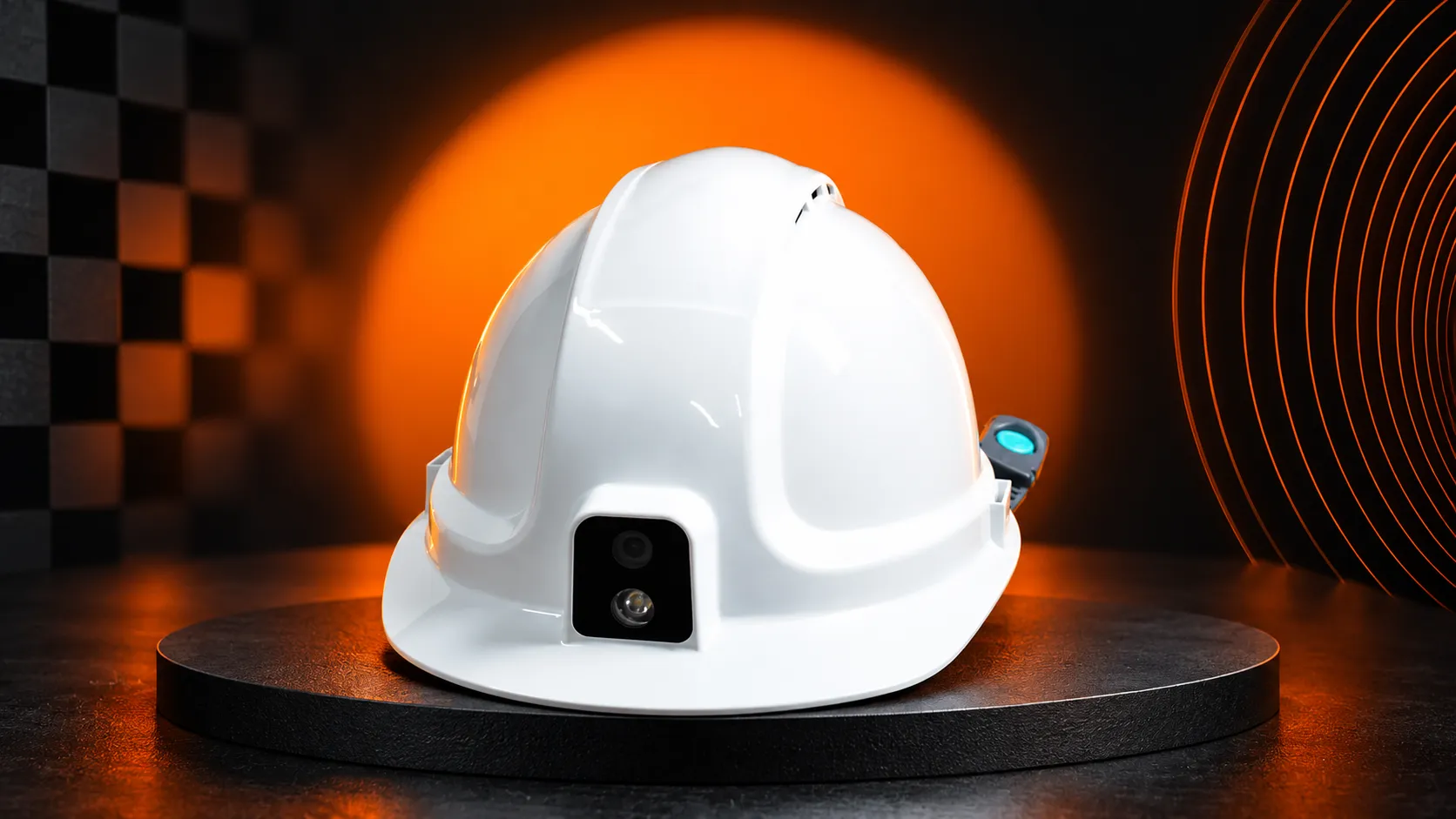
Precision vision retrofit on the packaging line

Adding machine vision inspection to an existing packaging line can be practical without replacing the entire machine. The first step is to establish what must be inspected, whether the defect is visible, and how the line will identify and remove a failed pack.

For US packaging-equipment manufacturers upgrading machines already installed at customer sites, this is a system integration decision. Cameras and software must work with the available space, product movement, existing controls and maintenance routines.

This guide explains how to assess retrofit feasibility, choose an inspection approach and prepare a specification that engineering partners can quote against.
Can You Add Vision Inspection to an Existing Packaging Line?

A retrofit typically combines cameras, lenses, lighting, image processing and a connection to the machine controls. Depending on the application, it may also require mounting brackets, an enclosure, product guides or a rejection mechanism.

The inspection station needs to capture a usable image, make a decision and associate that decision with the correct pack. Mechanical installation, PLC communication and reject handling are all part of the inspection system.

Before selecting equipment, check these five conditions:

Feasibility checkWhat to establish

Product visibility

Can the camera see the feature or defect? Will rotation, overlap or packaging material obstruct the view?

Available space

Is there room for the camera, lighting, mounting hardware and maintenance access?

Product movement

What are the operating speeds, pack spacing and changes in orientation?

Controls interface

How will inspection triggers, results and fault signals connect to the existing PLC?

Failed-pack handling

Where will a rejected pack go, and how will the system confirm its removal?

A line with predictable product presentation and an accessible inspection point is generally easier to assess than one with uncontrolled rotation or tightly spaced packs.

If the view is unreliable, changing the camera may not solve the problem. Mechanical guides, a different inspection position or a separate station may be necessary.

For an equipment manufacturer planning upgrades across several customer sites, also identify which machine configurations are consistent and which require individual assessment. A retrofit proven on one machine is not automatically ready for every installed variant.

Define the Defects Before Choosing the Equipment

“Check packaging quality” is too broad to specify or validate.

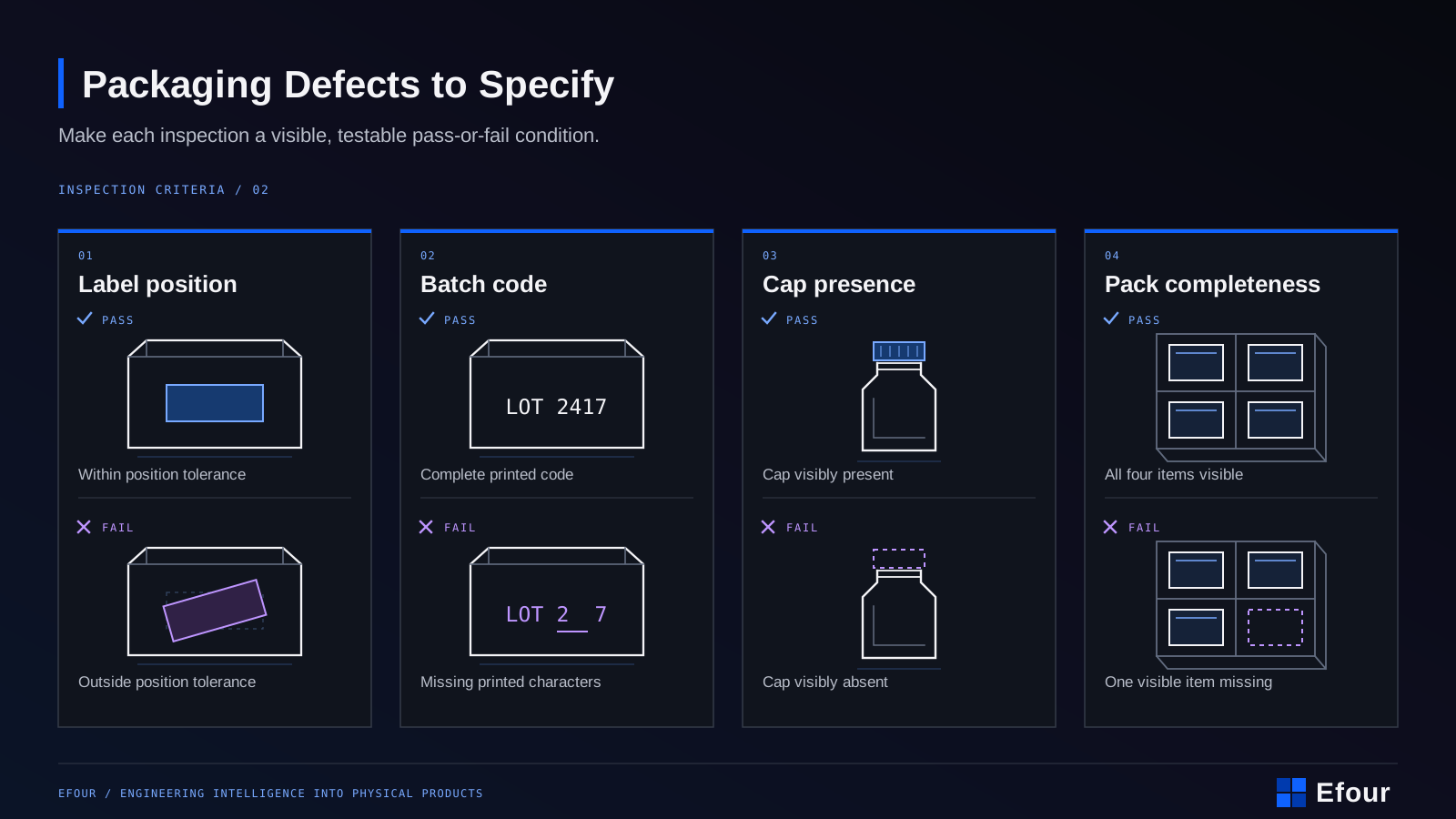
Describe each inspection as an observable condition with an agreed pass or fail result. Include acceptable variation, such as normal print differences or slight changes in label position.

Efour Packaging Defect Comparison

Inspection taskDefine before requesting a quotationImportant limitation

Label presence and position

Required label, permitted position and acceptable rotation

Presence alone does not confirm that the label is correct.

Date or batch-code inspection

Expected content, print location and acceptable readability

Reading characters and confirming their correctness are separate tasks.

Cap or closure inspection

Presence, visible alignment and the views needed

Appearance alone does not establish closure torque or leak tightness.

Pack completeness

Required items, count and acceptable arrangement

Hidden or overlapping items may require another view or inspection method.

Visible packaging defects

Defect types, minimum relevant size and acceptable surface variation

Visual inspection does not establish properties that are not visible.

Packaging inspection systems commonly combine label checks, code reading, presence verification and visible-defect inspection. The appropriate configuration depends on packaging material, presentation, throughput and the specific defect.

Prepare samples of good, defective and borderline packs. Include the variations encountered in production, not only clean samples selected for a demonstration.

Where people disagree about whether a sample should pass, resolve that disagreement before expecting the inspection system to apply a consistent rule.

Choose the Camera, Lighting and Processing Approach

Start with the inspection task, then choose the components.

A camera’s resolution is only one part of the decision. The lens determines the view, lighting makes relevant features visible, and the processing system must complete the inspection within the available time.

System elementThe question it must answer

Camera and lens

Can the required feature be captured clearly across the expected positions and movement?

Lighting

Can the defect be distinguished from reflections, shadows and acceptable material variation?

Processing

Can all required checks finish at the agreed operating speed?

Mounting and enclosure

Will the installation remain stable, accessible and suitable for the operating environment?

Controls and data interface

Can results reach the PLC and required records reach the customer’s systems?

Standard Smart Camera or Integrated Vision System?

A smart camera combines image capture and processing in one device. An integrated system may use separate cameras, a vision controller or an industrial PC, together with application-specific software and controls.

Neither approach is automatically better.

RequirementA standard smart-camera approach may fitAn integrated system may be worth evaluating

Inspection scope

A defined check from one view

Several views or inspection stages

Results

Straightforward pass or fail

Combined decisions from multiple cameras

Operator interface

Standard configuration and display tools

Custom workflows, recipes or screens

Records

Limited result logging

Image retention, traceability or wider data integration

Deployment

Repeatable stations with similar requirements

Different machine layouts or substantial integration constraints

Capabilities vary by product. Confirm them against actual inspection samples and operating requirements rather than relying on architecture labels alone. Smart cameras, vision controllers and PC-based systems can also be combined within a larger installation.

Custom engineering does not necessarily mean developing every component from scratch. It can mean selecting established cameras and lighting, then engineering the mounts, controls, interfaces and application around the machine.

Where the retrofit requires custom electronics or firmware, embedded product development connects those components with the machine’s operating requirements.

When Does AI Add Value?

Conventional vision methods should remain part of the evaluation for defined measurements, presence checks and code inspection.

AI-based inspection is worth considering when acceptable products and defects vary in ways that are difficult to describe with fixed rules, such as certain appearance or surface-defect tasks.

The choice should follow testing on representative samples. Ask:

Which defects can the proposed method detect?

Which acceptable variations cause false rejects?

How does performance change with lighting, material or product format?

Who maintains the configuration or model after installation?

An AI label is not a substitute for acceptance testing.

For a broader explanation of that decision, see how Efour evaluates AI for physical products.

Connect Inspection Results to the PLC and Reject Mechanism

A correct inspection result is useful only if the machine acts on the correct pack.

The PLC, or programmable logic controller, coordinates machine operations. The retrofit must define how it exchanges triggers, results and fault information with the vision equipment.

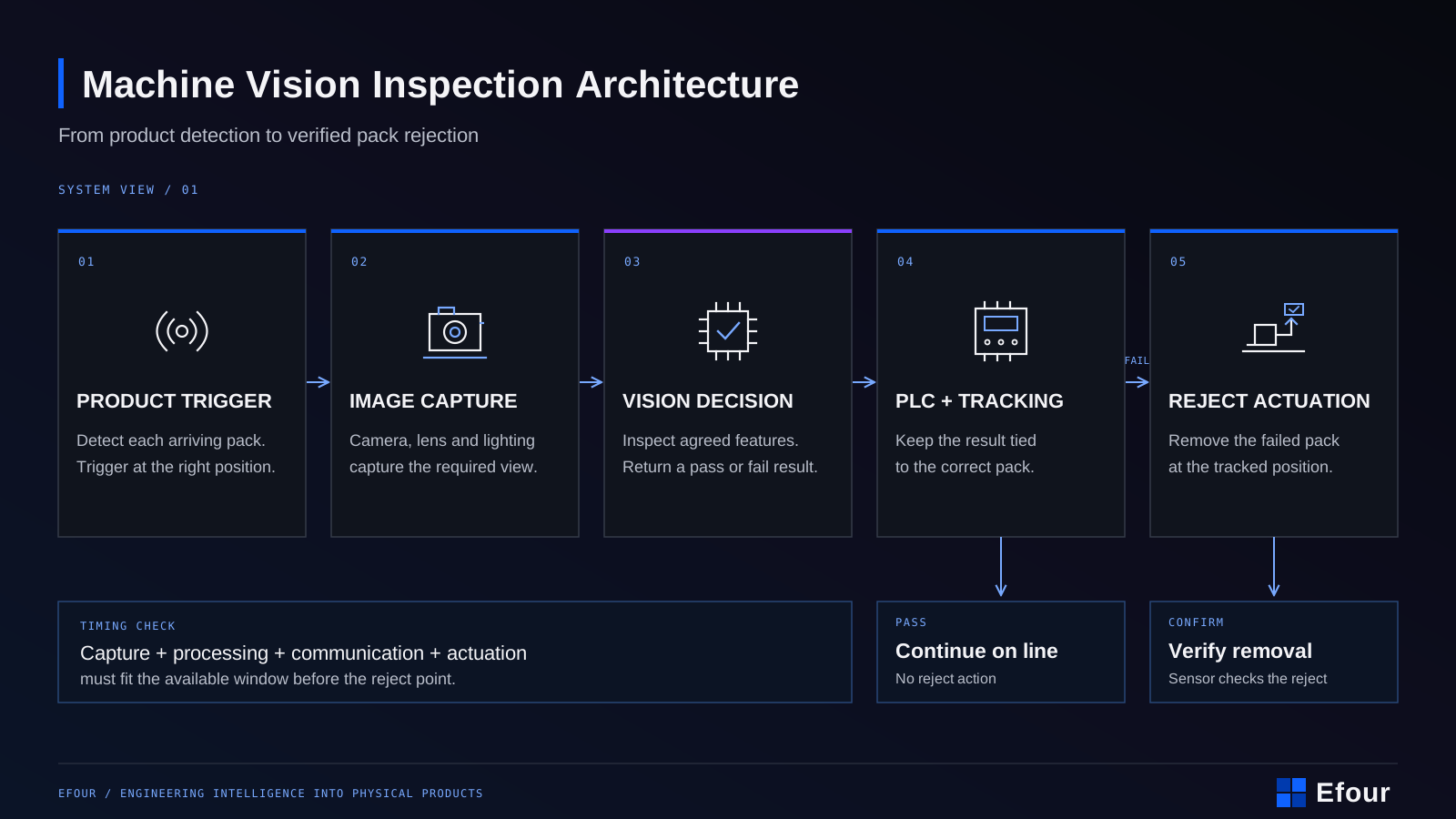
Efour Machine Vision Inspection Architecture

Inspection sequence: A pack reaches the inspection point, then the system captures and inspects its image. A passing pack continues through the line. A failed pack is tracked to the reject point, removed and checked to confirm successful rejection.

The engineering specification should cover the entire sequence:

Triggering: What tells the system that a pack is ready to inspect? The trigger must match the actual product position.

Decision timing: How long is available for capture, processing and communication before the pack reaches the rejection point?

Pack tracking: How will the result remain associated with the correct pack when speed or spacing changes?

Rejection: What mechanism removes the pack, and can it operate without disturbing adjacent products?

Confirmation and faults: How is successful rejection verified? What should happen if an image is missing, communication fails or the reject mechanism is unavailable?

These requirements should be agreed with the machine and controls engineers. Do not leave operating behaviour during faults to an installer’s assumption.

Define PLC handshakes and reject handling alongside the camera installation.

For installed equipment, record the customer’s controller version, available interfaces and existing modifications. Two machines carrying the same model name may have different integration requirements.

Agree on Acceptance Criteria Before Comparing Quotations

A statement such as “high accuracy at production speed” is not a testable specification.

Define what success means for the agreed products, defects and operating conditions. Evaluate missed defects and false rejects separately: accepting a defective pack and rejecting a good pack have different consequences.

The following table is a starting point, not a universal acceptance standard.

Acceptance itemWhat to agreeEvidence to request

Defect detection

Defect classes and acceptable missed-defect limits

Results against an agreed sample set

False rejects

Acceptable rejection of conforming packs

Results across normal product variation

Operating speed

Required speeds, spacing and test conditions

Performance records from representative runs

Changeovers

Supported formats and recipe-selection process

Demonstration across agreed formats

Reject handling

Tracking, removal and confirmation requirements

Tests showing the correct packs are removed

Fault behaviour

Response to missing images, lost communication and equipment faults

Witnessed tests of agreed scenarios

Data records

Required results, images, timestamps and retention

Sample records and retrieval demonstration

Sample sizes, thresholds and test duration should be agreed for the application. Avoid accepting a demonstration on a handful of obvious defects as proof of production performance.

A useful machine vision specification connects representative samples, measurable requirements and final acceptance testing.

Compare the Complete Retrofit Cost

Ask suppliers to separate the quotation into:

Inspection equipment, including cameras, lenses and lighting.

Mechanical work, mounts and enclosures.

Controls integration and rejection equipment.

Configuration, testing and validation.

Installation, commissioning and operator training.

Licenses, spares, maintenance and ongoing support.

For packaging-equipment OEMs, distinguish first-machine engineering from repeat-installation costs. Confirm what can be reused and what must be reassessed at each customer site.

A simple payback calculation can support the decision:

Simple payback = total installed cost ÷ annual net benefit

Use the customer’s documented figures for scrap, rework, inspection effort and other measurable losses. Deduct recurring costs and avoid counting the same saving twice. Do not assume that every detected defect would otherwise have become a customer complaint.

Prepare a Quotation-Ready Retrofit Brief

A clear brief helps an engineering partner identify feasibility questions early and reduces the risk of comparing quotations with different scopes.

Include the following information:

Brief itemInformation to provide

Machine and installation

Manufacturer, model, configuration and installation location

Products

Packaging formats, dimensions, materials and planned variations

Inspection requirements

Defect definitions, acceptable variation and sample images or physical samples

Operating conditions

Speeds, spacing, orientation and changeover requirements

Physical layout

Photos or drawings, available mounting space and proposed inspection position

Controls

PLC details, available interfaces and existing trigger or encoder signals

Reject handling

Existing equipment, available space and confirmation requirements

Environment

Cleaning practices, temperature, dust, moisture and other relevant constraints

Records

Required images, results, retention and integration destinations

Delivery scope

Installation window, acceptance responsibilities and number of machines

Also identify who owns the project after commissioning. Operators need clear procedures, maintenance teams need access and spares information, and engineering teams need controlled configuration records.

Planning a vision inspection upgrade for an existing packaging machine?

Explore Efour’s engineering capabilities, then share your machine details, inspection requirements and operating constraints to discuss the hardware, embedded and integration scope.

Discuss Your Packaging-Machine Retrofit

Frequently Asked Questions

It may be possible if the PLC has suitable interfaces and sufficient capacity for the required coordination. Confirm the controller, communication options, timing requirements and permitted program changes before choosing the vision equipment.

Potentially. Each format must fit the system’s imaging, lighting, processing and handling capabilities. Specify the required formats and test the changeover process, including recipe selection and any mechanical adjustments.

There is no reliable universal figure. It depends on mounting work, electrical changes, controls integration and rejection equipment. Ask the supplier to separate preparation that can happen beforehand from work requiring a stopped line, then agree on commissioning and contingency arrangements.

Custom engineering is worth evaluating when standard equipment cannot meet the required views, mechanical layout, controls interfaces, data handling or deployment needs. Where a packaged system meets the specification and acceptance tests, it may be the more appropriate choice.

Related Articles

Collaborative AI Engineering Lab
Product Engineering

How We Approach AI Product Engineering at Efour

AI product engineering isn’t about adding a model to an existing device. It’s about engineering a physical product in which intelligence, hardware, firmware, connectivity, and manufacturing constraints work together.

Paresh Sagar

Paresh Sagar

Nov 6, 2026

Industrial hard hat visual for the custom versus off-the-shelf platform comparison
Product Engineering

Custom Smart Hard Hat Platform vs Off-the-Shelf: How Industrial Teams Should Decide

For most industrial teams, the right call is neither extreme: start from a proven base helmet, and customize the platform layer that owns your integrations, data and workflows.

Mahil Jasani

Mahil Jasani

Nov 2, 2026

Engineering Solutions to Waste Management
Product Engineering

Engineering Solutions to Waste Management

Waste management has moved past hauling and landfill logistics into a design, materials, and systems problem. This guide breaks down the five categories of engineering solutions to waste management — prevention, circular recycling, energy recovery, treatment and disposal, and smart monitoring — covering what’s proven, what’s emerging, and how different industries apply each one.

Paresh Sagar

Paresh Sagar

Oct 26, 2026

Smart hard hat pilot program planning for an industrial site
Product Engineering

Smart Hard Hat Pilot Program: A 90-Day Rollout Plan for One Site

A pilot program succeeds or fails on adoption, not on hardware. A helmet that streams live video and runs push-to-talk voice over 4G does nothing for a site if half the crew leaves it in a locker. Any 90-day plan worth following has to be built around that fact from day one, not treated as a training problem to solve in week six.

Hitesh Gambhava

Hitesh Gambhava

Sep 24, 2026